
Thank you for signing up to serve with Blacknall Children’s Ministry!
Please review all information below! You may also wish to bookmark this page for easy access later.
At the end of each section there is an associated question. Fill in your answer and click submit before moving to the next question. Each of these answers is anonymized unless you provide your name in the box. If you want a response, please provide your name!
At the bottom of this page there are additional resources and a Children’s Volunteer Covenant. We will not be able to record that you have completed training unless you submit your name on the covenant.
Alright, let’s get started!
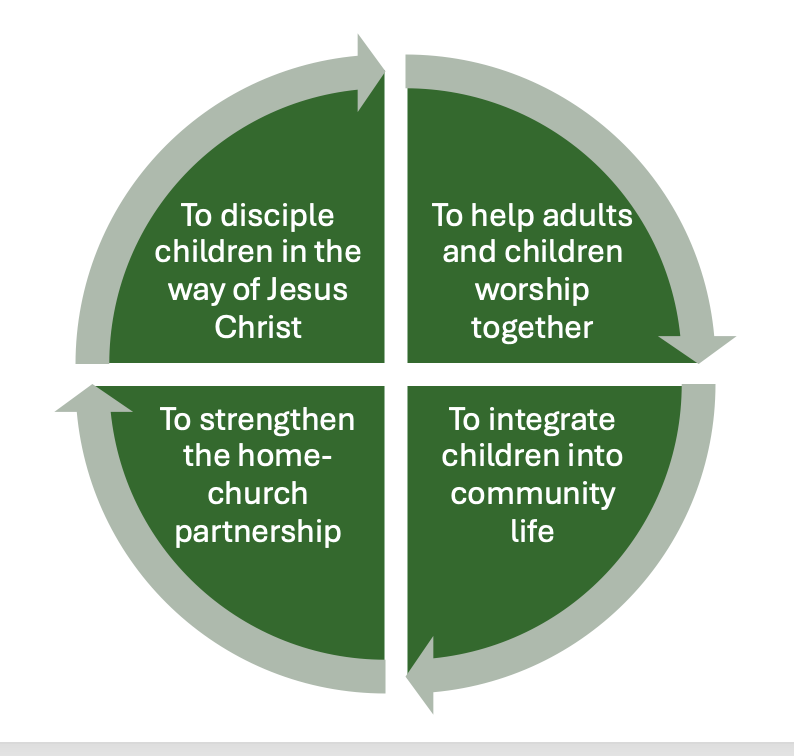
Why does Blacknall Children’s Ministry Exist?
The fourfold vision of Children’s Ministry is…
To disciple children in the way of Jesus Christ
Sunday School and Children’s Worship are primary vehicles for this!
We disciple children by working with the Holy Spirit in forming hearts, souls, minds, and strengths to love the Lord.
To help adults and children worship together
We WANT children in the sanctuary with us.
We teach kids how to worship in Children’s Worship
Have you seen our pew cards?
To integrate children into community life
Engaging in intergenerational relationships (nursery service!)
Marking transitions and helping children grow into the church (Communicants, 3rd Grade Bibles, Camp Discover)
To strengthen the home-church partnership
Catechism, Lent/Advent boxes
Special Events/classes to engage with families about Monday-Saturday faith
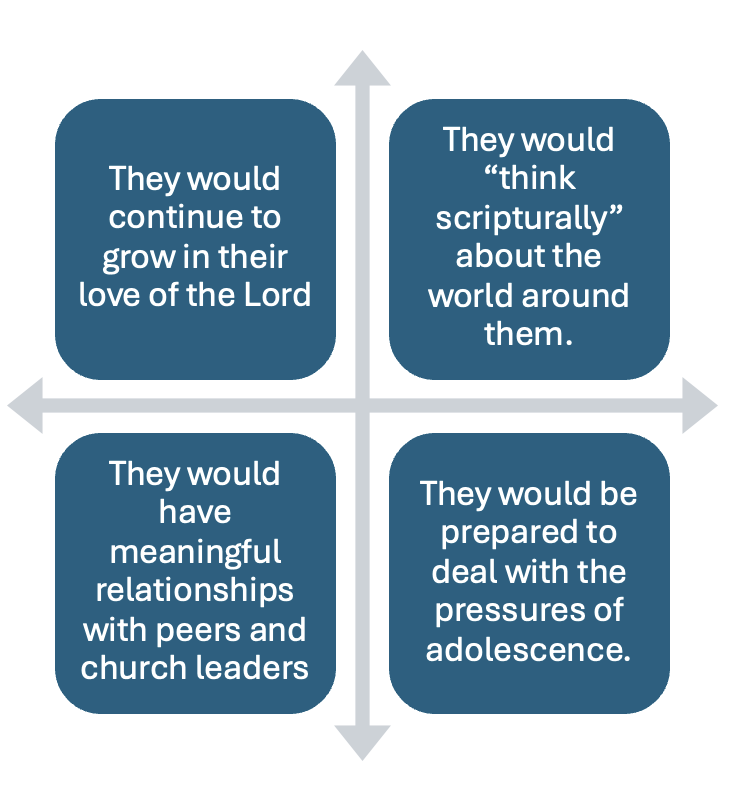
2. What are our hopes for children at Blacknall?
Our hopes are that our children would grow to love the Lord their God with all their heart, soul, mind, and strength (Mk 12:30-31). But how does this play out?
HEART
We hope that they would continue to grow in their love of the Lord
SOUL:
We hope that they would have meaningful relationships with peers and church leaders
MIND:
We hope that they would ‘think scripturally’ about the world around them
STRENGTH:
We hope that they would be prepared to deal with the pressures of adolescence
We do not passively hope for these things to come to pass. By active participation with the Holy Spirit, we work to bring these hopes about, while releasing the outcome to the Lord.
3. What age(s) are you leading?
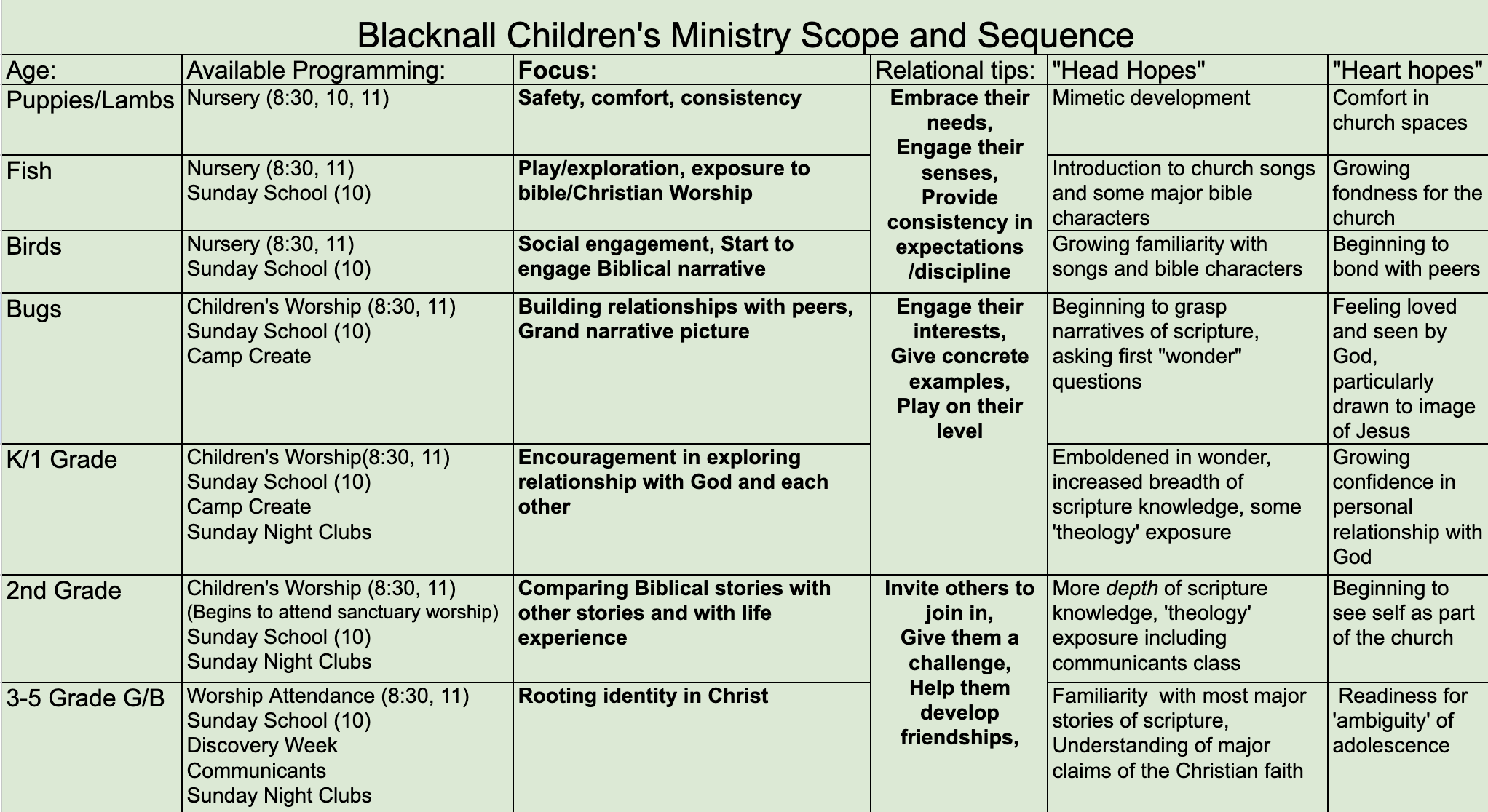
4. Dwell
**This section is specifically for Bugs and K-5 Sunday School teachers. If you are not a Bugs/Elementary Sunday School teacher you can skip this section and write N/A in the box below!**
We are continuing to use Dwell for 2026-2027! If you have logged in before, you should be able to log in again in the same way. If you provide your email address below, I will check on access, and if you are not currently in the system, I will send you an invitation. This is only for Bugs & K-5 Teachers, if that’s not you, you can skip this question.
Once you have an account, you can access every lesson at digital.dwellcurriculum.org. Click your age group, then click YEAR 2 (for K-5 teachers), then the unit and session for the given week (full schedule below). Once you do this, there is an option to pull up the pdf version of the lesson. I recommend doing this as it is much easier to follow. There is also always and already a hard copy version of the lesson in your Sunday School room. If you have any questions, reach out to Brandon!
One note: we did opt out of the take home cards this year for budget/engagement reasons. But everything else should be consistent from last year.
Scheduling
I have mapped out the semester for each of our classes, to try to get the most out of the curriculum and hit on the lessons that Dwell does best. Here are the suggested curriculum dates for each room in the Elementary Hall.
2nd Grade Class Suggested Dates
3rd-5th Grade (Girl/Boy) Suggested Dates
(Bugs, since you are on a one-year schedule instead of 2, you should be able to simply work through the curriculum linearly)
Almost every class gets off at some point and that’s okay, but try to stick with the prescribed dates if you can. If a lesson title is highlighted in yellow, it means that that date contains a lesson we’ve written to plug holes in the curriculum. If you are running off on weeks, let me know so I can adjust lesson-writing!
Important Note:
Everything is skippable.
If you try to fit EVERYTHING that Dwell suggests in the lesson plan into your 45 minute Sunday allotment, you (and the children) will go crazy. Feel free to choose what works best for your class. In a couple weeks, you will likely learn what works with your class and you can start choosing the activity types that drive engagement.
Also…
In every class there are at least 2 teachers who have done this thing before. Lean on their wisdom around what it looks like to plan a lesson.
5. Catechism Moment
**This section is specifically for Elementary (K-5) Sunday School teachers. If you are not an Elementary Sunday School teacher you can skip this section and write N/A in the box below!**
Hey friends, we are going to do something new this academic year. We have been using Curious Catechism for about a year, and we have learned a lot during that time! I remain convicted that it is a good resource and that driving engagement around it is a positive goal. It introduces our kids to core theological concepts that Dwell does not touch, and it connects with many of the questions that kids naturally have as they mature. This year, I am asking that all of our Elementary (K-5) Sunday School classes hold 2-5 minutes at the front end of class for a Catechism Moment.
The shape and tenor of this moment will look different depending on your age group, but this should be a short gathering activity with two components. There will also be a guide in each room with details laid out.
Memorization moment (1 question for four weeks)
For K/1 I suggest using hand motions, for 2nd graders I suggest using clapping with the bold words, and for the older kiddos, I suggest going straight through it. Challenge the kids to memorize the q and a by the end of the four weeks. (If you are the kind of person asking “WHY?!” I have got an answer for you down below)
Focus moment (Different question every week)
While we will stick with the same question for memorization throughout the four weeks (typically the easiest, most basic question from the series), we will still have time to engage with the other questions of the series for the other 3 weeks. FOR EXAMPLE — the first series is on the doctrine of God. For the first four weeks the “memorization moment” will be “How many Gods are there?” each time. But the FOCUS moment will change each week. Week one it will be “What is God’s name?” Week 2 it will be “How many Gods are there?”, week 3 will be “What is the Trinity”. The guide will include activity/segue suggestions but as always feel free to make it your own. Again, this should only take 2-5 minutes!
Curious about what this might look like for your class? You can check out the first drafts below:
2nd Grade Catechism SERIES 1 Guide
3-5 Girls and Boys Catechism SERIES 1 Guide
——————
FAQs
So… why are we doing this?
The Biblical basis of Dwell is strong, and engaging with the Bible together is crucial to children’s spiritual development. Our Dwell curriculum works “from the ground up” cementing our children’s formation through Scripture. Engaging with the catechism is supposed to work the opposite way. Instead of going “from the ground up”, we are providing connective tissue to help us understand what is fundamentally true about the God we meet in Scripture. Hopefully, it can provide some deeper context and exploration that helps our biblical lessons make even MORE sense.
Too often in children’s ministry we don’t actually focus on imparting theological concepts, instead opting to focus on scriptural exposure. Scriptural exposure is integral to how we do children’s ministry. But we also want to provide theological connective tissue that can enlighten the Bible stories they read and help them see the present-day truths of the God we worship. We want to offer a space for theological curiosity to flourish, and I hope including the catechism here can be a first step.
What if I disagree with one of the questions as it is posed?
Option 1: If you can retain your integrity and have another teacher lead the engagement with that question I would start there. Option 2: Please don’t be afraid to reach out and share your reservations. We don’t want to have blindspots about the words we use, and you might effect a change in our wording.
Where did this catechism come from?
Brandon, Pastor Goodie, and Kaitlyn Schiess (former member and current podcaster/children’s worship engagement expert) sourced these questions from the Westminster Catechism, Heidelberg Catechism, The Book of Common Prayer, Presbyterian Book of Confessions, and several other sources. Then they updated the language to be more kid-friendly, added some fresh activities, and said “Voila!”
What if I like REAAALLLYY don’t want to do this?
Will you at least give it an effort for this first semester? And I don’t mean like a half-hearted try, I mean like actually trying. Because it would be really valuable to have the data of how our kids truly engage after at least a couple months of engaging like this. If it goes TERRIBLY, I want to hear about that! That will effect how/if we think about using the catechism in the future!
Does this mean we’re done using the catechism in the worship service?
For now we are transitioning out of using it in the Children’s Blessing. It was too public and abbreviated a space to engage with the catechism in the way it was designed to be used. But we will continue to explore avenues of engagement with the catechism as a congregation.
Our lesson time is already so full. How are we supposed to fit this in?
It may mean swapping out the “gathering” activity that Dwell suggests in order to fit it all in. If the catechism moment consistently goes too long, you might need to set a timer to make sure you mark when it is time to move on!
6. Abuse Prevention & Safety
Abuse Prevention Protocols
At Blacknall, we use the “Darkness to Light” abuse prevention curriculum. We hold trainings at least annually and are encouraging folks to make sure they complete a training at least once every 5 years. If you have not yet completed a training, this does not preclude you from participating as a leader, but we do need you to commit to attending the next available Darkness to Light training if at all possible.
We are currently doing a safety audit as we rewrite our policies to ensure we are keeping our children and each other safe. Once our new handbook is complete, we will share this broadly. In the meantime, you can see our previous edition here. Here are a few highlights:
There should always be at least two adults present in the room with any group of children
If an adult is temporarily in the room alone (if the other adult present is having a conversation with another child OR taking a group of children to the bathroom), the door should be left open so that anyone walking past would be able to see into the room.
For children PreK(4) and up, adults should not enter the bathroom with children, and should not let more children into the bathroom than the number of available stalls
We also encourage the adult leader to knock and make sure bathrooms are empty before sending children in.
For children who are in diapers, adults should change diapers within site of other adults
For children who are potty training, adults should leave the door to the bathroom ajar and only enter into the bathroom when asked by the child
Any adult who is uncomfortable with assisting a child in this situation will be able to opt out.
Please report any suspicious behavior even if you’re “not sure”.
Any information about possible abuse is treated very seriously.
You can report to the Coordinator of Children’s Ministry, the Director of Children’s Ministry, or one of the pastors
Additional Safety Protocols
First Aid Kits are available:
The Commons above the sink
The Nursery desk
Before administering any care, wash hands, use gloves. If a nurse or other medical professional is available, have them provide first aid
If there is an incident in which first aid needs to be administered, please fill out the Incident Report Form available at the nursery desk.
In the event of a fire:
All nursery classrooms (Ground floor) should exit through the closest exterior door, take the kids down the alley toward 9th street, and congregate under the awning of the closest businesses.
All elementary classrooms (First floor) should exit through the Commons and take the kids down Iredell to “The Yard”
Take attendance often and have one adult lead and one adult “sheepdog”
From your safety location, children can be dismissed to parents
In the event of an armed individual
Exit the building swiftly and surely using the same plan as in the event of a fire.
If it is judged to be safer to hide than run, we will lock down in the Children’s Worship Rooms facing the wall.
7. Quick Links and Extras
Catechism
Calendar of Catechism Questions
2nd Grade Catechism SERIES 1 Guide
3-5 Girls and Boys Catechism SERIES 1 Guide
DWELL
2nd Grade Class Suggested Dates
3rd-5th Grade (Girl/Boy) Suggested Dates
Other
Policy for the Protection of Children and Youth
Blacknall Children’s Ministry website